"Better Living, Through Not Getting Killed"
A Journal of Integrated Combatives, Self Defense, Survival and Weapon-craft.
Tuesday, December 16, 2008
A Lesson on Combat Knives, in Two Parts: The MOD XSF-1, and the Mil-Tac CS1
There is, in the knife community, an undue fascination with “fighting” and “combat” knives. Lots of collectors, enthusiasts, and makers specialize in these types of blades. Some of them are fine people, but most with an interest in, or god save us an opinion on, such knives lack the weight of need or experience to lend their ideas validity. Yet it is often this lot who have their voice raised above those of the truly experienced and it is their cacophony which drives a large part of the "tactical" knife world. Not because they are right, but often because they have, if nothing else, immense buying power.
However, there remain voices and talents in the industry who, on the weight of their background or the strength of their products, have every right and reason to speak up. Not that they always do, some of these talents seem to prefer letting their products do the talking, and keep their voices low. Some are out-spoken, and on the vocal forefront of the industry, but have earned their place there. In either case it is to these talents that people of an experienced need and background go for cutlery. They do so trusting that what they are buying is not hype, is not a “name”, is in fact nothing but a well designed, well executed performance tool.
These opposing forces are not in balance however. The demand for knives to suit the enthusiast market is much higher than for knives to actually be used, particularly in the “tactical” field. There is money to be made from the fancy, the different, the new and shiny. Hype and gadgetry have made more people money than reliability and proven forms...
[Read The Rest: Click Here]
.
Thursday, March 30, 2006
Folding Utility Knives


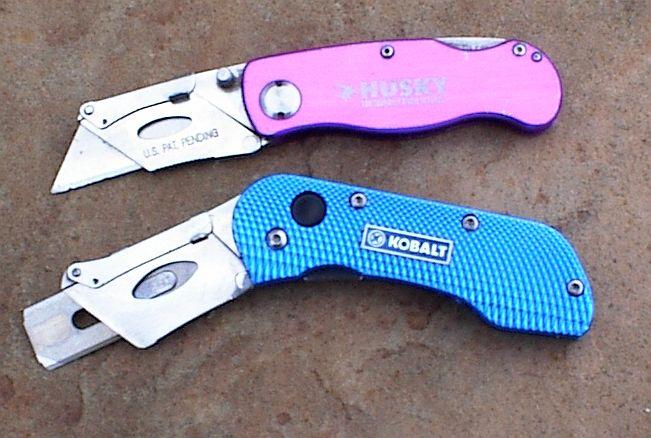
The folding utility knife is nothing new - its been around for awhile, with some pretty good quality ones having come out in the past couple of years. I think the first one I was aware of was the SuperKnife, which is probably still the best quality of them on the market, but there are several different brands out there now. Including several, of essentially the same type, that are being logo-branded by tool companies like Husky, or Kobalt, and sold cheaply in big-box hardware stores like Lowes.
I've had one of these, a Husky labeled utility knife, for awhile now and use it to cut assorted stuff around my knife making shop. Its a good tool, well made with a solid lock and a comfortable handle.
Just yesterday at Lowe's I picked up a folding Carpet Knife, with the nice double-edged razor style blade. A liner lock, this. Good lockup too.
The "low-profile" non-weapon weapons aspect of these tools is obvious; as a more concealable successor to the venerable box cutter. I have actually carried mine in the non-permissive environment on a couple of occasions. Not my first choice, but it is an option.
The box-cutter (and similar utility knives: carpet knives, linoleum knives) have long been a favored "Street weapon". I've seen more than one homeless guy with one in his back pocket and read more than one news article about some poor sap who stepped around the wrong corner and got one to the face and throat. I recall one article about a guy who got his neck sliced open by a gang member, ran all the way to the hospital hands clamped around his neck, and lived. He was fucking lucky.
In the UK a common name for edged weapons is "Stanleys" thanks to the good old Stanley box-cutter.
There is probably not a one of us that doesnt remember the role of the meager box-cutter in the 9/11 attacks.
Going back even further, I remember....
[Read The Rest: Click Here]
Saturday, May 21, 2005
Realistic Application of Sleight of Hand
Many people in the field of combatives, particularly edged weapons combatives, have devoted hours and thousands of words to the subject of slight of hand in relation to the use of weapons. I have encouraged those who would listen to read this material, consider it and practice it.
Some question this, and fail to see the relevance of learning the stage magicians skill with weapons. I can understand that, I didn’t “get” it for a long time either – but there is value to it, and it can be considerable.
Sleight of hand can be used to create fatal deceptions, tricks against the eye and mind of your opponent to defeat him, but it can also be used to hide something you don’t want seen by non-combatants. Active concealment is the term I use for the hiding, disguising or directing the eye away from a weapon that is in hand/in play.
Leading up to or during an engagement active concealment is a disguise or deception that tricks your opponent into giving you a place to hurt him, or draws him into a false confidence putting him between the rock and the hard place of “get hurt or get hurt”.
Post-engagement, during retreat/Nike-ryu/Escape & Evasion, active concealment is hiding your tools still at hand, as you quietly slip away from the scene.
Although you can plan it and execute your concealment to the prescribed pattern, the height of your ability to use sleight of hand and active concealment as fluidly as any other combat skill, acting and reacting with your environment as needed, with “no-mind” more than conscious effort. This is why we study and play with things in the safety of our own home, so that when we need them they come naturally.
Not long ago a close friend of mine had an incident in which he was forced to adjust the attitude of an aggressive drunk in a movie theater bathroom. Although the drunk had four buddies, he made the mistake of being the only one between my friend and the door. After assisting the drunk in breaking a wall tile with the back of his head, my friend stepped past him and out the door just as a police officer was walking in. My friend, smelling booze walking into the bathroom, had palmed a folding knife and it was still in his hand as he left. That hand having just come off the attackers face, it was up at eye level, palm out, with the knife still pinched in place by the thumb. Turning his palm inwards and muttering something along the lines of “Damn, those guys are drunk! So much for taking a piss” my friend looked the officer right in the eyes, then looked over his left shoulder drawing the officers gaze away from his right side as they passed. With his right side passing first, he slipped the folder into his pocket and let his hand dangle at his side as he walked calmly down the hallway to the exit. He used misdirection with his eyes, body position, verbal distraction (talking draws attention to you, but right choice of words kept the cop focused on what he was there for anyway) and sleight of hand to safely leave the scene without causing any other incident.
When he first told me about this we had to spend some time remembering what he did to divert attention away from his right hand and not accidentally present as a threat to the police officer, and be able to keep on heading away from the fight and home. Adrenaline clouds the mind, yes, but this too goes to the “no-mind” of a true skill, it comes when needed without forced thought to make it so.
His relatively short time spent practicing and playing in front of the mirror with a few simple ideas and concepts had paid off – when he needed it, it came naturally and probably saved him at the very least several hours worth of hassle.
Such a successful use of sleight of hand can almost seem unimportant when performing it, it is so subtle that even you can be lost to its quiet deceptiveness. This is a skill worth taking time with, on all levels. Learn what you can do with your eyes, hands, voice, feet and body. These ruses, deceptions, tricks and camouflages can save your life, end your enemies and keep you the “grey man” afterwards.
Some essential eReading on this subject, some of it directly related, some of it you have to make related through your own work.
Magic by Don Rearic http://donrearic.com/Magichoudini.html
Subliminal Gestures by J.A. Keating http://donrearic.com/SignalsKeating.html
Sleight of Hand in Knife Fighting by James Sass http://donrearic.com/sass1-sleightofhand.html
Now You See It, Now You Don’t by Pete Kautz http://alliancemartialarts.com/magic.html
Deceptions by James Keating http://www.jamesakeating.com/MjkG.html
Motion Camouflage http://www.dcs.qmul.ac.uk/~aja/motion_cam.html
Angle of Anothers Gaze http://www.rense.com/general38/gaze.htm
Monday, May 16, 2005
The Crash Axe as a Tool of Terrorist Interdiction

Onboard most commercial aircraft are a selection of survival and rescue tools such as fire extinguishers, first aid kits, defibrillators and crash axes. Although the crew knows where such items are they are usually stowed behind unmarked panels that normally go unnoticed by passengers.
Most crash axes, although built to double as fire axes, are more along the lines of a hatchet in size, ranging between 16” and 20” long with a hatchet or tomahawk sized head. The smaller size allows them to be stowed easily and makes them easier to use inside the confines of an aircraft. Several types of FAA approved crash axes exist, but the average size envelope remains the same.
The two designs I have personally encountered are as follows: The first having a hatchet head, with a hammer on the reverse and a pry-bar extension protruding from the top, the second closely resembles the World-War II era “SPAX” military crash axe. This second axe is in fact much closer to the original SPAX in design than the current version manufactured by Ontario Knife Company, although the difference is mainly in the handles.
The value of these items as survival and rescue tools is well proven, documented and understood but there is another dimension to their usefulness. Although after the significant act of 9/11 the likelihood of further airline hijackings or incidents involving airplanes is reduced the possibility still exists. Lone extremists and “crazies” acting without direction from a group (save possibly the voices in their head) still can pose a threat. Airline related terror has had an extremely high international visibility in recent years and has a strong recognition level with the general public, making it an obvious and prominent choice for the lone actor.
[Read The Rest: Click Here]
About Me
- Combative Concepts
- A Journal of Modern Combatives & Survival
Authored by M. Atwood: Former EMT, Professional Knife-Maker, Blacksmith and Medical/Survival Kit Builder. Sometimes Instructor, and part-time Art Teacher.