"Better Living, Through Not Getting Killed"
A Journal of Integrated Combatives, Self Defense, Survival and Weapon-craft.
Tuesday, December 16, 2008
A Lesson on Combat Knives, in Two Parts: The MOD XSF-1, and the Mil-Tac CS1
There is, in the knife community, an undue fascination with “fighting” and “combat” knives. Lots of collectors, enthusiasts, and makers specialize in these types of blades. Some of them are fine people, but most with an interest in, or god save us an opinion on, such knives lack the weight of need or experience to lend their ideas validity. Yet it is often this lot who have their voice raised above those of the truly experienced and it is their cacophony which drives a large part of the "tactical" knife world. Not because they are right, but often because they have, if nothing else, immense buying power.
However, there remain voices and talents in the industry who, on the weight of their background or the strength of their products, have every right and reason to speak up. Not that they always do, some of these talents seem to prefer letting their products do the talking, and keep their voices low. Some are out-spoken, and on the vocal forefront of the industry, but have earned their place there. In either case it is to these talents that people of an experienced need and background go for cutlery. They do so trusting that what they are buying is not hype, is not a “name”, is in fact nothing but a well designed, well executed performance tool.
These opposing forces are not in balance however. The demand for knives to suit the enthusiast market is much higher than for knives to actually be used, particularly in the “tactical” field. There is money to be made from the fancy, the different, the new and shiny. Hype and gadgetry have made more people money than reliability and proven forms...
[Read The Rest: Click Here]
.
Thursday, March 30, 2006
Is Stainless Steel Good Enough for a Knife Blade?
As a knife-maker, and the moderator of knife (or knife related) forums for a few different internet bulletin boards over recent years, I very often hear people talking about high carbon steel being the only choice for a good knife. If they don’t say it directly, it is often something they have heard from someone else, saying something like “I was told if a steel doesn’t rust it wont make a good knife.”
Of course the up-shot of this is very often that stainless steel gets pandered, even unintentionally, and very good knives made of stainless are ignored or over looked. This is quite unfortunate, because the right stainless steel works extremely well.
I have a theory about this little phenomenon though - It is an issue of Carbon content.
Before we continue, let me establish a few “definitions”. Steel, in general, is divided up into two categories, and five subcategories that apply to the two main ones:
- Simple Carbon Steel – Steel of all types with less than 13% Chromium content.
- Stainless Steel – Steel of all types with more than 13% Chromium content.
Ø Very Low Carbon – Steel with up to 0.05% carbon content.
Ø Low Carbon – Containing 0.05 – 0.2%
Ø Medium Carbon – Containing 0.2 – 0.5%
Ø Medium-High Carbon – Containing 0.5 – 0.8%
Ø High Carbon – Containing 0.8% and higher
The higher the carbon content the better, but...
Folding Utility Knives


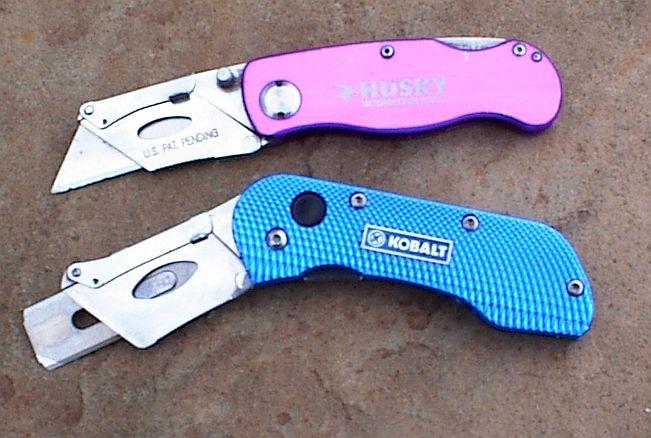
The folding utility knife is nothing new - its been around for awhile, with some pretty good quality ones having come out in the past couple of years. I think the first one I was aware of was the SuperKnife, which is probably still the best quality of them on the market, but there are several different brands out there now. Including several, of essentially the same type, that are being logo-branded by tool companies like Husky, or Kobalt, and sold cheaply in big-box hardware stores like Lowes.
I've had one of these, a Husky labeled utility knife, for awhile now and use it to cut assorted stuff around my knife making shop. Its a good tool, well made with a solid lock and a comfortable handle.
Just yesterday at Lowe's I picked up a folding Carpet Knife, with the nice double-edged razor style blade. A liner lock, this. Good lockup too.
The "low-profile" non-weapon weapons aspect of these tools is obvious; as a more concealable successor to the venerable box cutter. I have actually carried mine in the non-permissive environment on a couple of occasions. Not my first choice, but it is an option.
The box-cutter (and similar utility knives: carpet knives, linoleum knives) have long been a favored "Street weapon". I've seen more than one homeless guy with one in his back pocket and read more than one news article about some poor sap who stepped around the wrong corner and got one to the face and throat. I recall one article about a guy who got his neck sliced open by a gang member, ran all the way to the hospital hands clamped around his neck, and lived. He was fucking lucky.
In the UK a common name for edged weapons is "Stanleys" thanks to the good old Stanley box-cutter.
There is probably not a one of us that doesnt remember the role of the meager box-cutter in the 9/11 attacks.
Going back even further, I remember....
[Read The Rest: Click Here]
About Me
- Combative Concepts
- A Journal of Modern Combatives & Survival
Authored by M. Atwood: Former EMT, Professional Knife-Maker, Blacksmith and Medical/Survival Kit Builder. Sometimes Instructor, and part-time Art Teacher.