"Better Living, Through Not Getting Killed"
A Journal of Integrated Combatives, Self Defense, Survival and Weapon-craft.

Saturday, December 27, 2008

WoundStat Update

After only recently announcing that Z-Medica's Combat Gauze, and another hemostatic product called WoundStat were the new standard for Tactical Combat Casualty Care, the Army has pulled one of them following the 2008 Special Operations Medical Association conference.
WoundStat was found to have a severe risk of causing occlusive thrombosis (clotting leading to blockage), deeper inside the body than simply at the wound site. The Army has issued directives for all WoundStat to be turned in, and it's use to be discontinued pending further testing.

I'll post two bits that were passed along to me via email regarding this.
First, the FRAGO that went out regarding discontinuation of WoundStat:
FROM
CDRUSAMMA FT DETRICK MD//MCMR-MMO-SO//

***PRIORITY***MESSAGE NOT RELEASED

****************UNCLASSIFIED****************

SUBJ: T0B-1218-002
NEW SOLDIER HEMOSTATIC DRESSINS / WOUNDSTAT / MEDICAL INFORMATION


REFERENCE: ALARACT 239/2008, NEW SOLDIER HEMOSTATIC DRESSINGS

1. THIS FRAGO DIRECTS TEMPORARY CESSATION OF USE OF WOUNDSTAT™ (WS) BY 68W
COMBAT MEDICS AND ALL OTHER PROVIDERS DUE TO NEWLY IDENTIFIED SAFETY CONCERNS
ABOUT THIS PRODUCT, PENDING FURTHER EVALUATION.

2. WOUNDSTAT™ WILL BE TURNED IN TO THE MEDICAL SUPPLY SYSTEM IMMEDIATELY.
UNIT SUPPLY PERSONNEL WILL TURN -IN WOUNDSTAT™ TO THEIR SUPPORTING MEDICAL
SUPPLY SUPPORT ACTIVITY (SSA). THE ARMY MEDICAL SSA WILL REVIEW TRANSACTION
REGISTERS AND COMPLETE 100% CONTACT WITH UNITS ISSUED WS TO ENSURE TURN-IN
OF PRODUCT. ARCENT WILL SUBMIT THE TOTAL NUMBER OF WS ISSUED AND COLLECTED
TO OTSG. THE ARMY MEDICAL SSA WILL HOLD WS UNTIL FURTHER NOTICE OR UNTIL DISPOSITION
INSTRUCTIONS ARE RECEIVED FROM OTSG.

3. DATA FROM THE US ARMY INSTITUTE OF SURGICAL RESEARCH (USAISR) SHOW THAT
WS IS ASSOCIATED WITH A HIGH INCIDENCE OF BLOOD VESSEL THROMBOSIS AND DAMAGE
TO THE VESSEL WALL. COMBAT GAUZE AND PLAIN KERLIX WERE NOT ASSOCIATED WITH
SIMILAR FINDINGS. USE OF COMBAT GAUZE IS SAFE, ACCORDING TO CURRENT STUDIES,
AND DISTRIBUTION AND USE SHOULD CONTINUE.

4. MEDICAL PERSONNEL MUST LOCATE AND EXAMINE ALL CASUALTIES PREVIOUSLY TREATED
WITH WS TO VERIFY ADEQUATE LIMB PERFUSION, IF WS WAS USED TO TREAT EXTREMITY
WOUNDS.

5. EXPIRATION DATE CANNOT BE DETERMINED.


And, an email originating from Frank Butler (whose name should be immediately familiar if you've been doing your homework):
-----Original Message-----
From: Butler, Frank K., CTR [mailto:[redacted]@med.navy.mil]
Sent: Wednesday, December 24, 2008 12:35 PM
Subject: WoundStat Message

Forwarded FYI.

The attached message reflects safety concerns about WoundStat presented by
Dr. Bijan Kheirabadi from the U.S. Army Institute of Surgical Research at
the recent Special Operations Medical Association conference.

Dr. Kheirabadi observed that 7 of 8 animals on whom WoundStat was used in a
carotid artery bleeding model developed occlusive thrombosis and had no
blood flow 2 hours after suturing of the wound.

The implications of this study for both WoundStat and hemostatic agent
testing in general are currently under review.

Note that WoundStat currently serves as the "Last Resort" of medics' options
to stop life-threatening external hemorrhage. TCCC guidelines call for
tourniquets, Combat Gauze, and WoundStat in that order. When used
appropriately, WoundStat is the medic's last intervention to stop a casualty
from bleeding to death from external hemorrhage in a location not amenable
to tourniquet use.

V/R -

Frank

Frank K. Butler, Jr. M.D.
CAPT MC USN (RET)
Chairman
Committee on Tactical Combat Casualty Care


The summary of Dr. Kheirabadi's presentation should be up on the SOMA site sometime in the near future.
Further testing and independent evaluations will undoubtedly happen, and will either put the final nails in WoundStat's coffin, or possibly out it as safe for use with an improved protocol.
Until I hear differently however, WoundStat is off my list. Fortunately, I dont own any, but was thinking about adding some given its 100% effectiveness in testing. As of now, however, WoundStat is a no-go.
Sticking to Z-Medica (QuickClot) Combat Gauze, and QuickClot Sponges.

Tuesday, December 16, 2008

A Lesson on Combat Knives, in Two Parts: The MOD XSF-1, and the Mil-Tac CS1


The Mil-Tac Combat Survival 1 (Left) and the Blackhawk XSF-1 (Right)

There is, in the knife community, an undue fascination with “fighting” and “combat” knives. Lots of collectors, enthusiasts, and makers specialize in these types of blades. Some of them are fine people, but most with an interest in, or god save us an opinion on, such knives lack the weight of need or experience to lend their ideas validity. Yet it is often this lot who have their voice raised above those of the truly experienced and it is their cacophony which drives a large part of the "tactical" knife world. Not because they are right, but often because they have, if nothing else, immense buying power.
However, there remain voices and talents in the industry who, on the weight of their background or the strength of their products, have every right and reason to speak up. Not that they always do, some of these talents seem to prefer letting their products do the talking, and keep their voices low. Some are out-spoken, and on the vocal forefront of the industry, but have earned their place there. In either case it is to these talents that people of an experienced need and background go for cutlery. They do so trusting that what they are buying is not hype, is not a “name”, is in fact nothing but a well designed, well executed performance tool.
These opposing forces are not in balance however. The demand for knives to suit the enthusiast market is much higher than for knives to actually be used, particularly in the “tactical” field. There is money to be made from the fancy, the different, the new and shiny. Hype and gadgetry have made more people money than reliability and proven forms...

[Read The Rest: Click Here]


.

Thursday, December 11, 2008

Foundations

This summary is not available. Please click here to view the post.

Tuesday, November 18, 2008

A Proposed Guideline...

A Proposed Guideline for Tactical Medical Self-Care in the Civilian Environment:

by Morgan Atwood, © Not For Redistribution w/o Permission & Attribution


Overview:

In environments involving violent use of firearms, knives, and other weapons capable of inflicting life threatening penetrating trauma (which we might call Tactical Environments for lack of a better term), there exists a need for medical management guidelines specifically addressing the unique concerns of said environment. The military and police communities have addressed this with adoption of the military generated Tactical Combat Casualty Care guidelines. Recognition of the risk of injury in the tactical environment, and the need for improved, tactically sound, care methods for those engaged in violent encounters has slowly begun seeping into the civilian context of armed/self-protection minded citizens. What information exists, however, is generally gleaned from the documents and training created around the military/police contextual model, which differs significantly from that of the armed citizen engaged in self defense.
The civilian environment lacks the protections afforded by operating in small units which can provide suppressive fire to protect dedicated medics, and members of which generally wear body armor and protective equipment. Injury sustained in the civilian environment must be self stabilized, for lack of better options, until professional care arrives. The safety and security of the environment in which the care is delivered is also up to the individual most likely suffering the injury. The armed citizen is triple-tasked to negate active threats, use cover and effective fire (not volume) to secure themselves, and provide their own care for stabilization of a life threatening injury in the “Platinum 10-minutes” after it occurs. This demand for self-care is only heightened by the inevitable delay in arrival of emergency medical services, given response times and the need for police to declare a scene secured prior to EMS entering.

Meeting the needs of medical care in civilian engagements can be accomplished via...


[Read The Rest: Click Here]


Revisiting

Its been a long time since I did any work with this blog. Originally conceived as an addition to a dot com website of the same name, my intent with this blog was to have a place to put shorter, more random and less prepared thoughts and ruminations, while still using the website to host complete articles, reviews and other more finished materials. All on the topics of personal preparedness/defense, concealed carry, integrated combatives, and the like.
That was then. A lot of things have changed and been left behind. My website is currently non-operational, though I am working on getting it back online, and with a lot of new material. But I still want a place to dump some thoughts and ideas, and this is going to be it for now.
Stay tuned... More is coming.

Monday, April 03, 2006

Learning Vs. Repeating

I had a disturbing exchange recently with a member on one of the discussion boards I moderate for. He was having a hard time grasping a concept of blade usage and design, and was asking me some questions to try and work that out. He did get the idea, on his own I might add, which is always great - I love those "aha!" moments myself - When telling me about it he mentioned a course he'd been to about the knife method at hand, and to explain why it didnt "click" with him then he said "I just did what I was told".
I was greatly disturbed by that.
Bright, intelligent people, go to a class to learn something, but when the instructor starts teaching instead of learning, they mimic. They follow directions, but they dont try to understand why.
What we do at training courses is follow the instructors instruction so that we can learn it - but thre is a difference between doing it to learn it, and simply repeating what the instructor demonstrates without any effort to understand it.
Sometimes its the fault of the instructor, no doubt - but sometimes its the fault of the person training. I know the modern school system for standard education is fond of saying there are no bad students, but thats bullshit. It is possible to be a bad student. Many people are.
We have to apply critical thinking to our defensive training, from practical unarmed combat to edged weapons to firearms. We have to see beyond the motions, and understand what they accomplish.
Unless that understanding is achieved we havent really learned any skill - we've repeated some motions, and maybe learned how to repeat them in the future.
A skill is something you can access repeatedly, under diverse and challenging circumstances outside previously experienced parameters. You need skills, the flexible, adaptable, software that is the core of any "fighting program".
Patterns of by-rote mechanics are one trick ponies, not skill.
You run into this problem a lot in traditional martial arts, being taught to the traditional method of that art - the student stands there, repeats a hundred perfect combinations of something, and thats it. No effort is encouraged to understand what thats for, or how it can be applied. You run into elsewhere too, the shooting community for example (the people, even instructors, who do perfect, flat footed, range presentations and double taps to paper targets - over and over and over - and think thats "good enough"), but one example is as good as another. If you arent one of those people, dont get your panties in a bunch. If you are... your anger should be directed at yourselves, not me. Dont shoot the messenger just because he forced you to look at something nasty about yourself.

There's a great Bruce Lee quote that goes something like "Before I studied the art, a punch was just like a punch, a kick just a kick. After I learned the art, a punch was no longer a punch, a kick no longer a kick. Now that I've understood the art, a punch is just a punch, a kick just a kick".
I've always liked that. When you are just repeating a thing, its simple but its useless, you have no way to practically apply it.
When you understand a thing, have learned not only how to perform it but why and when, it is no more complicated than it ever was, but now its not a repetition - you have the skill to use it, its become a tool.
You can draw a picture of a wrench, do shadowing and paint it in silver and it'll look like a wrench, you can even cut it out and hold it in your hand. But if you try to turn a nut with it, it'll tear apart.
But If you go to Sears and buy a wrench, and know righty-tighty/lefty-loosey (except for gas lines ;) ), you can do your work.

When you train, learn what you are doing, dont just repeat what your instructor is doing. The instructor has to teach in an environment condusive to learning, but you as the student have an equal responsibility to make yourself open to actually learning. Make the effort to think about what you are doing, the mechanics of it, what it achieves, and what it allows. If you cant "get it", be self-aware enough to realize that, and to ask a question to answer it. Asking questions isnt a sign of the fool - just the opposite.

Thursday, March 30, 2006

Is Stainless Steel Good Enough for a Knife Blade?

As a knife-maker, and the moderator of knife (or knife related) forums for a few different internet bulletin boards over recent years, I very often hear people talking about high carbon steel being the only choice for a good knife. If they don’t say it directly, it is often something they have heard from someone else, saying something like “I was told if a steel doesn’t rust it wont make a good knife.”
Of course the up-shot of this is very often that stainless steel gets pandered, even unintentionally, and very good knives made of stainless are ignored or over looked. This is quite unfortunate, because the right stainless steel works extremely well.

I have a theory about this little phenomenon though - It is an issue of Carbon content.

Before we continue, let me establish a few “definitions”. Steel, in general, is divided up into two categories, and five subcategories that apply to the two main ones:

  • Simple Carbon Steel – Steel of all types with less than 13% Chromium content.
  • Stainless Steel – Steel of all types with more than 13% Chromium content.

Ø Very Low Carbon – Steel with up to 0.05% carbon content.

Ø Low Carbon – Containing 0.05 – 0.2%

Ø Medium Carbon – Containing 0.2 – 0.5%

Ø Medium-High Carbon – Containing 0.5 – 0.8%

Ø High Carbon – Containing 0.8% and higher

The higher the carbon content the better, but...


[Read The Rest: Click Here]

Folding Utility Knives


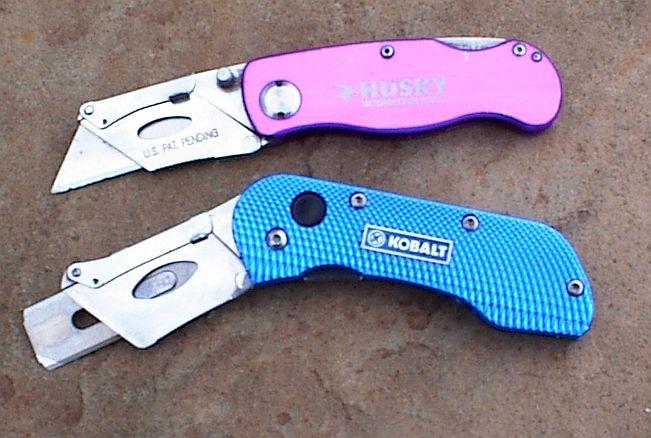
The folding utility knife is nothing new - its been around for awhile, with some pretty good quality ones having come out in the past couple of years. I think the first one I was aware of was the SuperKnife, which is probably still the best quality of them on the market, but there are several different brands out there now. Including several, of essentially the same type, that are being logo-branded by tool companies like Husky, or Kobalt, and sold cheaply in big-box hardware stores like Lowes.
I've had one of these, a Husky labeled utility knife, for awhile now and use it to cut assorted stuff around my knife making shop. Its a good tool, well made with a solid lock and a comfortable handle.
Just yesterday at Lowe's I picked up a folding Carpet Knife, with the nice double-edged razor style blade. A liner lock, this. Good lockup too.

The "low-profile" non-weapon weapons aspect of these tools is obvious; as a more concealable successor to the venerable box cutter. I have actually carried mine in the non-permissive environment on a couple of occasions. Not my first choice, but it is an option.
The box-cutter (and similar utility knives: carpet knives, linoleum knives) have long been a favored "Street weapon". I've seen more than one homeless guy with one in his back pocket and read more than one news article about some poor sap who stepped around the wrong corner and got one to the face and throat. I recall one article about a guy who got his neck sliced open by a gang member, ran all the way to the hospital hands clamped around his neck, and lived. He was fucking lucky.
In the UK a common name for edged weapons is "Stanleys" thanks to the good old Stanley box-cutter.
There is probably not a one of us that doesnt remember the role of the meager box-cutter in the 9/11 attacks.
Going back even further, I remember....

[Read The Rest: Click Here]

Friday, March 10, 2006

Desperate Circumstances call for Desperate Measures

In emergency situations no one thinks quite like they do normally. I've always been proud of myself for being a "cool head" when things are seriously going wrong but as I have read more and studied more about mental processes and particularly the decision making process under stress, and paid more attention to my own mind, even I know that the way I think under stress is not the way I think when I am calm, comfortable and safe.
Something I think a lot of people are prone to under stress is making decisions that, for a more immediate or easier reward, add a small, temporary, amount of risk to the situation.
At a certain point some additional risks bring about a greater benefit than not taking them - I can remember being 14 and driving 70 down a dirt road it could be dangerous to go 45 on, with my mom in the passenger seat apparently having a heart attack. It was a near-fatal potassium imbalance, as it turned out, but no less dangerous. There was risk to driving that fast, although the road was in good condition it was also un-predictable to a certain extent and not safe at higher speeds. There was also a greater risk if not driving fast - at a normal speed of 35mph its an hours drive to meet the ambulance. At 70, its half an hour. I knew I could handle the vehicle at 70, I wasnt an inexperienced driver. The risk, under the circumstances, was worth the reward.
But some risks arent.
People tend to say "desperate circumstances call for desperate measures" when faced with an emergency situation, as a way to justify driving a little faster or taking other additional risks for perceived gains - but it can be dangerous.
Tonight was the first night of the season we've needed to heat the house. This is a 60+ year old ranch house and is still dependant on wood-fired heat. For fun, and to at least encourage my skills, I built the fire somewhat by-hand, using a knife to break large kindling into splinters and make fuzz sticks and starting a little pile of shavings burning with some flakes off a magnesium block, then adding to it with larger pieces until I had a fire. Nice, cedar and pinon fire that went from a little bit of flame to a great roaring fire.
But, I had to stop myself at one point while I was splitting cedar into fine kindling. I caught myself slipping the knife blade under a large splinter and starting to pull it back towards my hand holding the piece of wood. The first lesson my dad ever taught me about a knife, when I got my first one at 6 years old, was to never cut toward myself. I've proved him right many times, and gone with him to the hospital when he proved himself extremely right one day a few years ago. I never want to cut myself, it sucks. As a knife-maker, I do it a lot, but it still sucks and I still dont like it. I like $1000.01 bills (the exact bill the last time I had stitches) for less than ten stitches even less.
But, it struck me, if I was really stuck somewhere miserable and cold (on a night like tonight, its still early fall but the temp has dropped fast and its snowing but earlier today I was out in short-sleeves), trying to build a fire, how much would I hurt myself to cut my hand, even minorly? How handicapped would I be with my hand cut, bandaged and maybe restricted or completely useless? What if I seriously injured myself, hit the artery in my arm, or slipped even further trying not to cut myself and stuck it in my thigh?
And would it have been worth it? No. It was taking a short-cut to something it would have only taken me a second longer to do right, turn the stick around and whittle the splinter off from a safe direction.
Easily learned lesson - no pain, no suffering. Most good lessons dont come so easily.
Desperate circumstances can call for desperate measures - but not stupid ones. Theres never an excuse for being stupid and dangerous.

Friday, March 03, 2006

"Women Should Be Dressed in White, Like Other Kitchen Appliances"

I think by now we've all heard the line that is this posts title, and know the stink it caused when the honcho of Formula 1 said it about, and to, Danica Patrick (Indy 500 4th place finisher). I'm not a racing fan, at all, and I heard it. If not, JFGI
What relevance does racing, or misogyny in that good ol' boys club have to self defense/combatives?
The former, not much, the latter? A lot.
Like a lot of male dominated fields, there is a lot of misogynistic behavior in the communities of firearms and combatives enthusiasts/practicioners/instructors.
Just recently on one of the forums I frequent there was a discussion that came up on what "women need to know" to successfully protect themselves. Several of the comments were less than heartening....
"Bring her man with her..."

"The most important thing a woman needs to know? The PIN number to the debit card."
This is, sad to say, typical.
This field is, pretty much, a boys club - particularly when we start talking about the serious innovators, those who work and train hard and distill the best, most cutting edge, software from their experience and study.
Now, most of these gentlemen, are just that - Gentlemen. But, theres the occasional internet poster, or range officer, or gun-store clerk who has the "Women should be dressed in white, like other kitchen appliances attitude."
And generally, even those of us who do not like that attitude, we ignore it. We dont call people on it, dont make waves.
The problem with that is when our daughters, wives, mothers, or girlfriends run into that attitude - on one of the boards we post on, and have encouraged them to visit, or in a gun store or at a range. Especially if they are new to the whole thing, just getting their feet wet, and maybe already a little bit uncomfortable.
That kind of attitude can be like running into a brick wall - If it was just starting to get interesting, or fun, one nasty run in like that can end the fun.
It just takes once, and the whole thing is over - you wont get her to go back to the range, or back on the board, again.

We may think its funny - But the women in our lives dont. I can be a sexist bastard just jokingly (I laughed at the "Women should be dressed..." comment), but not around my girl.
Frankly, any woman who puts up with our shit, deserves better - especially if she is beginning to accept her responsibility to protect herself, and expressing an interest in learning more about it.
Sexism, misogyny, even in fun, has no place in serious discussion, or training, involving women.
There's some real pieces of shit out there, who want to do horrible things to our queens. The ladies in our lives need every chance they can have, to get every advantage they can get.

Now, in answer to the "Whats the most important thing for a woman to know question", here is an excellent comment from James Yeager of Tactical Response:
"That it is just as right and just for her to defend herself as it is to defend her children."

Thursday, January 05, 2006

Survival Skills

"Could You Survive?" - What an excellent question!
When someone brings up wildnerness survival most peoples minds seem to make an immediate jump to the sensational: a plane crash in the wilds of Alaska, a boat being moved off course by a hurricane and stranding its passengers on an uncharted (or simply uninhabited) island. But the truth is much more mundane that that.
People driving through the mountains break-down, and freeze to death because they dont know how to build a fire. Hikers get lost because they didnt prepare, and dont know how to deal with panic. People get hurt, or die, all the time because of simple things like a flat tire and no spare, taking the wrong trail, a horse falling with them and leaving them alone in the high country with a broken leg and a storm coming.
I have never even seen a plane crash in a remote wilderness, or a ship wreck on a desert island, but I have been broken down on the side of a dirt road 50 miles from the ass-end of nowhere as the temperature crept below Zero. I have been in the high country, stranded for one reason or another, collecting drinking water, building fires to cook and stay warm. I have met people who got lost on a day hike, didnt have any food, had run out of what little water they had and who might still have been stumbling around country they didnt know in the dark if they hadnt...

[Read The Rest: Click Here]

Monday, December 19, 2005

Slumming It - Thrifty Gear Practices


Gear is not what makes the man, especially not the fighter - but gear is a great aid to us in self defense and survival. The right gear, good gear, can make your life that much easier.
Concealment vests, solid and reliable footwear, etc. are key elements for how many of us "dress for success" when appropriate.
The right clothing is essential for survival in harsh conditions.
A nice gear-bag to stow all your off-body kit in helps keep things organized so you can find stuff when you need it.
You can spend hundreds of dollars on all these items - and they are well worth it. Or, occasionally, you can get lucky.
I've got a favorite thrift store that I visit occasionally to get cheap books (First Editions are a hobby and side-business for me, and this is a great source) and just have a look-see at what they have.
A couple months ago I found a really nice reversible lightweight synth-fleece vest, no label but of high quality manufacture, that makes a really nice cover garment. Paid around $5 for it.
Today, I stopped by there again, and managed to make several good finds.
I found a very nice PolarTec brand cold-weather hood/neck covering - in excellent shape, no stains, tears, or busted stitching. Excellent piece of kit, $1 - for an extra buck each I grabbed two good watch caps, one Old Navy synthetic fleece in "friendly" yellow, and one of wool. I'm big on watch caps, and am always glad to have a few around.
I found a fairly spiffy Old Navy bag, sort of a "messenger" style but a little larger - Faux surplus gear, made out of canvas and actually very sturdy. Lots of pockets, and "stylish" enough to blend nicely, and still "tactical-ish" enough to make me happy. Around $5.
Found another interesting vest, this one for $15 - black with OD green interior and edge binding, multi pocket, fairly well made nylon vest, "modern urban wear" of some sort. Drapes well, should make a nice cover garment (looks "faux-tactical", which just blends as being hip) - and has the interesting feature of having a small backpack built into the back. No idea how much it can support, but am going to put it to the test. Even if that aspect of it is crappy, its another good vest - emergency fall-backs in case something happens to my KAVU Baranof.
And, last but certainly not least - on my way to check out I happened to see a pair of boots that looked nice, so I checked them out. A brand new (I mean brand new, clean, un-scuffed, perfectly clean soles and still the "new shoe" smell) pair of Rocky 9" Basic duty-boots - a MSRP $230 "tac" boot - and in my size. The price you ask? $29.
So a Thrift Store may not be anything like the equal of your local tac-gear shoppe, but keep your eyes out - you never know what you might find.

Friday, September 30, 2005

16-Hour Survival (or "The Little Events that Become Emergencies") - A Way of Life


The power just came back on a couple hours ago, after having been off for a little over sixteen hours. It went down while we were gathered around the idiot-box last night watching, of all things, Survivor.
Now, this isnt uncommon out here. I live an average (there's two ways out) of 45 miles from a paved road, and about 60 miles from any town of more than 1,000 people. There is one power line that runs out here - it serves about 18 homes, and was put in in 1998 on the condition of a 15 year fixed-rate contract (average of $500 a month) to pay for the installation costs.
The reason the power goes out a lot here is thus two-fold: Its a single line, with no backups or ways to re-route power around a problem like in the city, or even rural areas surrounding a city. So, if something happens, until its fixed we're without power. The second half of the equation is that its 40 miles of line, strung between poles, through some pretty rough and busted up country that can wash like crazy when it does rain. It stands alone as a major attraction for lightning. So, if lightning doesnt hit it, the rain washes something out, and so on. A myriad of problems can happen in 40 miles of isolated, and ignored (until there is a problem) line.
So, what happened this time? A power-pole washed out in the large rains we've had recently, and they couldnt get any trucks into the location (yes too rough for even 4wd) so they had to walk in with their gear to fix or replace the dislodged pole. Sixteen hours later, the power is back.
Most people probably think of that as a long time. Its not, not here. But, part of the reason its not is that we are prepared to deal with it better than most, especially those who dont live like this.
My family has been in this place pretty close to 100 years. My great-grandparents were homesteaders, and eventually expanded the homestead into what is the ranch of today. My grandparents lived here and maintained the ranch for many years until it came under the control of my mother, and she and my dad have maintained it since then. Until the 1980's there was no phone out here - and we didnt have one for many years after that - and until 1998 the only electricity came from generators and most light was provided for by kerosene lamps, the cooking done on gas or wood stoves, and heat from gas heaters or the wood-burning fireplace. We relied heavily on dry-storable foods because of the limited reliability of gas fridges. When the electric line came in, we didnt get rid of any of those things we just phased them out of primary usage.
So now, when the power goes out - we're fine. We have light, we have heat, we have food.

The largest issue created by the power going out is medical - two family members are on full-time oxygen, and use Concentrators (sort of like a "scrubber") as the source for that. The problem is that those machines run on electricity. The solution? Reserves of compressed-gas or liquid oxygen. There's always enough for a few days without power.
In this most recent event the medical issue was compounded by the road conditions thanks to the rain - dirt roads tend to become very hard to pass after a lot of rain. In the case of a medical emergency, you might not make it out or you may spend several more hours driving slow and digging out of mud holes, than the normal hour it takes to drive out in good conditions. A well stocked medical kit, and the skill to use it can go a long way to make anything that happens under these conditions more survivable. And once again, this is one of those things that several generations of living out has guaranteed is available.

If you are not prepared the 16-hour events can become major, even fatal, emergencies or survival situations. If you are prepared, 16 hours or even a few days "stranded" 45 miles from town without power becomes a lot easier. When its just part of a way of life, it really doesnt bother you.
I think the ideal "survival skills" should put you in between the "prepared" and "way of life" mindsets - unless you live like this, it isnt a way of life, but if you put your skills to use, get out and be out, then you should be able to improve your comfort level. If you're more comfortable with a situation you are clearer headed and more rational when actually having to make decisions under less-than-ideal conditions.

Sunday, July 24, 2005

Journaling and Training

Journaling is rather popular right now in all sorts of circles. Unlike a lot of other en vogue “pop culture” whatnots journaling is actually a very valuable tool. As a psych major I can tell you that journaling is a powerful tool for a person to learn more about themselves, and their lives. Things that may not have been apparent to us before writing down the days events, an argument with a family member, or at work, or just a string of emotions, can suddenly be very clear when writing. It can help to clear our heads, so that we can think more freely. It can also help us to retain things we’ve learned, and to work out ideas and new concepts, helping us with our continuous learning process.

The study of close quarter combatives is full of conceptualizations and new ideas, at least new for the student, and is definitely a continuous learning process. I have for a very long time kept notes and running journals about what I learn, new ideas and new concepts – and very often when writing out a thought or an idea, I will realize a mistake I was making or a new way of approaching what I’d been doing. It is very much like having a point/counter-point discussion with your self. It is a great aid to the concept of “Progression Training” as it helps the flow of ideas and improves the learning curve.
One important part of journaling is that you have to be comfortable doing it – this can mean calling it “my notes” and not “my journals”, or using particular notebooks or pens, or doing it in a particular environment. But for the real basic essence of journaling, all you need is a notebook and a pen. You don’t need a fancy leather bound notebook or fancy pens, just a plain old composition notebook and a Bic-Stic pen. If you want fancier, then get it – whatever makes you happy and comfortable, makes journaling easier. I actually have several “journals”, some for H2H, some for weapons, some for knife designs and notes on knife making, and they are all different.
There is no right way or wrong way to keep notes or journal. You don’t have to be deep, or philosophical, just write it out. What idea you just had, what your teacher imparted to you in the last class, what techniques you think you need to work on, anything. I have pages of my journals filled with bad sketches of the human anatomy as it applies to CQC, and sketches of fighting knives, others or my own designs, so I don’t have to tote around Grays Anatomy and all my knife books. Neat quotes, ideas, thoughts on classes, suggestions to yourself on what you need to improve, or how to possibly improve it. All this stuff can go in your notes. And if you don’t feel like writing after your training session or your class, you don’t have to. The idea is simply to keep a record of what you learn, your thoughts on things, so that as you write it out, or go back to it for reference, you can become clearer on things you are taught, or your own concepts.

Saturday, May 21, 2005

Realistic Application of Sleight of Hand

Many people in the field of combatives, particularly edged weapons combatives, have devoted hours and thousands of words to the subject of slight of hand in relation to the use of weapons. I have encouraged those who would listen to read this material, consider it and practice it.
Some question this, and fail to see the relevance of learning the stage magicians skill with weapons. I can understand that, I didn’t “get” it for a long time either – but there is value to it, and it can be considerable.
Sleight of hand can be used to create fatal deceptions, tricks against the eye and mind of your opponent to defeat him, but it can also be used to hide something you don’t want seen by non-combatants. Active concealment is the term I use for the hiding, disguising or directing the eye away from a weapon that is in hand/in play.
Leading up to or during an engagement active concealment is a disguise or deception that tricks your opponent into giving you a place to hurt him, or draws him into a false confidence putting him between the rock and the hard place of “get hurt or get hurt”.
Post-engagement, during retreat/Nike-ryu/Escape & Evasion, active concealment is hiding your tools still at hand, as you quietly slip away from the scene.
Although you can plan it and execute your concealment to the prescribed pattern, the height of your ability to use sleight of hand and active concealment as fluidly as any other combat skill, acting and reacting with your environment as needed, with “no-mind” more than conscious effort. This is why we study and play with things in the safety of our own home, so that when we need them they come naturally.
Not long ago a close friend of mine had an incident in which he was forced to adjust the attitude of an aggressive drunk in a movie theater bathroom. Although the drunk had four buddies, he made the mistake of being the only one between my friend and the door. After assisting the drunk in breaking a wall tile with the back of his head, my friend stepped past him and out the door just as a police officer was walking in. My friend, smelling booze walking into the bathroom, had palmed a folding knife and it was still in his hand as he left. That hand having just come off the attackers face, it was up at eye level, palm out, with the knife still pinched in place by the thumb. Turning his palm inwards and muttering something along the lines of “Damn, those guys are drunk! So much for taking a piss” my friend looked the officer right in the eyes, then looked over his left shoulder drawing the officers gaze away from his right side as they passed. With his right side passing first, he slipped the folder into his pocket and let his hand dangle at his side as he walked calmly down the hallway to the exit. He used misdirection with his eyes, body position, verbal distraction (talking draws attention to you, but right choice of words kept the cop focused on what he was there for anyway) and sleight of hand to safely leave the scene without causing any other incident.
When he first told me about this we had to spend some time remembering what he did to divert attention away from his right hand and not accidentally present as a threat to the police officer, and be able to keep on heading away from the fight and home. Adrenaline clouds the mind, yes, but this too goes to the “no-mind” of a true skill, it comes when needed without forced thought to make it so.

His relatively short time spent practicing and playing in front of the mirror with a few simple ideas and concepts had paid off – when he needed it, it came naturally and probably saved him at the very least several hours worth of hassle.
Such a successful use of sleight of hand can almost seem unimportant when performing it, it is so subtle that even you can be lost to its quiet deceptiveness. This is a skill worth taking time with, on all levels. Learn what you can do with your eyes, hands, voice, feet and body. These ruses, deceptions, tricks and camouflages can save your life, end your enemies and keep you the “grey man” afterwards.

Some essential eReading on this subject, some of it directly related, some of it you have to make related through your own work.
Magic by Don Rearic http://donrearic.com/Magichoudini.html
Subliminal Gestures by J.A. Keating http://donrearic.com/SignalsKeating.html
Sleight of Hand in Knife Fighting by James Sass http://donrearic.com/sass1-sleightofhand.html
Now You See It, Now You Don’t by Pete Kautz http://alliancemartialarts.com/magic.html

Deceptions by James Keating http://www.jamesakeating.com/MjkG.html
Motion Camouflage http://www.dcs.qmul.ac.uk/~aja/motion_cam.html
Angle of Anothers Gaze http://www.rense.com/general38/gaze.htm

Motion Illusions & Active Camouflaging http://www.ucl.ac.uk/~ucbplrd/motion/motion_middle.html

Monday, May 16, 2005

The Crash Axe as a Tool of Terrorist Interdiction


Onboard most commercial aircraft are a selection of survival and rescue tools such as fire extinguishers, first aid kits, defibrillators and crash axes. Although the crew knows where such items are they are usually stowed behind unmarked panels that normally go unnoticed by passengers.
Most crash axes, although built to double as fire axes, are more along the lines of a hatchet in size, ranging between 16” and 20” long with a hatchet or tomahawk sized head. The smaller size allows them to be stowed easily and makes them easier to use inside the confines of an aircraft. Several types of FAA approved crash axes exist, but the average size envelope remains the same.
The two designs I have personally encountered are as follows: The first having a hatchet head, with a hammer on the reverse and a pry-bar extension protruding from the top, the second closely resembles the World-War II era “SPAX” military crash axe. This second axe is in fact much closer to the original SPAX in design than the current version manufactured by Ontario Knife Company, although the difference is mainly in the handles.
The value of these items as survival and rescue tools is well proven, documented and understood but there is another dimension to their usefulness. Although after the significant act of 9/11 the likelihood of further airline hijackings or incidents involving airplanes is reduced the possibility still exists. Lone extremists and “crazies” acting without direction from a group (save possibly the voices in their head) still can pose a threat. Airline related terror has had an extremely high international visibility in recent years and has a strong recognition level with the general public, making it an obvious and prominent choice for the lone actor.

[Read The Rest: Click Here]


About Me

A Journal of Modern Combatives & Survival
Authored by M. Atwood: Former EMT, Professional Knife-Maker, Blacksmith and Medical/Survival Kit Builder. Sometimes Instructor, and part-time Art Teacher.